Sunday, January 12, 2014

Who Are These Boys ?

Rootsweb is returning a little at a time. Hopefully all the links in this article will come back online soon. In the meantime I was able to recover this at the Internet Archives: 

http://webcache.googleusercontent.com/search?q=cache:http://archiver.rootsweb.ancestry.com/th/read/Melungeon/2003-01/1043974727

Janet Crain


By Don Collins

Who Are These Boys ?

Anyone who has ever looked into the people who were called 'Melungins', has probably come across a photo taken by photographer Doris Ulmann. Sometimes called 'Melungeon Boys' or 'Melungeon Man and Boy'; this photo is all over the internet:


So how did this photo of these two boys become the template of the Melungin phenotype ?
Who are these boys ? Why are they called Melungin boys ?

This photograph was first published in 1971 in the book “The Appalachian Photographs of Doris Ulmann” by John Jacob Niles, Plate 40, named “Two Melungeon Boys”. Did Niles and the Ullman Foundation label this photo ?

The photo surfaces for a second time in 1997 on the KET (Kentucky Educational Television) 'In Search of Origins, Melungeons' produced by Ernie Lee Martin. 'Melungeon Boys' photograph is shown. Does Mr. Martin know who these boys are, by name, what makes him think they are of Melungin descent ? The start of the Melungin phenotype starts here. This falls right in line with the“PBKN” era (Post Brent Kennedy Nonsense) a phrase coined by Mullins researcher Gary Mullins, thanks Gary, and the start of the 'Melungeon Movement'  or as I call the Melungin train wreck, and the foundation is laid for the modern 'construct' of Melungeons, or what a Melungin might look like.

The third time this photo is published is on the cover and on page 230 of the book by Manuel Mira titled ““The Forgotten Portuguese, The Melungeons and Other Groups, The Portuguese Making of America”. Mira changes the name of the photograph to “ Melungeon man and boy” and states the photo was taken in the 1920's. So is Mira suggesting these boys are not only Melungins, but are also 'Portuguese' ?

How can he take that liberty, with out knowing who these boys are, what their names are, who their families are ?

In 2003, a discussion on the Rootsweb Melungeon List about the Ulmann photo between Kentucky natives Pat Spurlock, Cleland Thorpe and Brent Kennedy and Helen Cambell:


Be sure and look at the whole thread.

Also here where Jack Goins and Penny Ferguson discuss Doris Ulmann and the 'Melungeon Boys' photograph:


Kennedy never gave a straight answer to any of the questions asked him. If he would have stopped his verbalizing and done some research, he would have found out that Ulmann didn't always label her photos, and most of her photos were developed AFTER her death, literally thousands of photographs. After her death, the Doris Ulmann Foundation was formed and took over management of her vast portfolio.

“Upon Ulmann's death, a foundation she had established took custody of her images. Allen Eaton, John Jacob Niles, Olive Dame Campbell (of the Campbell Folk School in Brasstown, North Carolina), Ulmann's brother-in-law Henry L. Necarsulmer, and Berea schoolteacher Helen Dingman were named trustees. Samuel H. Lifshey, a New York commercial photographer, developed the negatives Ulmann had exposed during her final trip, and then made proof prints from the vast archive of more than 10,000 glass plate negatives. (Lifshey also developed the 2,000 exposed negatives from Ulmann's last expedition, and produced the prints for Eaton's book.) The proof prints were mounted into albums, which were annotated by John Jacob Niles and Allen Eaton, chair of the foundation and another noted folklorist, to indicate names of the sitters and dates of capture. Some 3,000 prints were also produced for Berea College in Kentucky, an institution with which Ulmann had worked with in the last year of her life to document the local crafts traditions. Columbia University was able to provide storage space for the Ulmann materials until the 1950s, when the Foundation was asked to seek a permanent home for the collection. Eaton, who had formerly taught at the University of Oregon, doubtless assisted in attracting the interest of the UO's Martin Schmitt, curator of Special Collections and an early proponent for recognizing historical value within photographs. Although many institutions expressed an interest, the University of Oregon was willing to commit to preserving the collection in its entirety, and became the permanent home of the Doris Ulmann Collection. However, prior to shipping the collection the Foundation made the decision to reduce the weight of materials being shipped by selecting and destroying some 7,000 glass plate negatives. Approximately 2,500 platinum prints docurmenting Ulmann's work in her New York studio were deposited with the New-York Historical Society.

The Ulmann collection includes 2,739 silver gelatin glass plate negatives, 304 original matted prints, and 79 albums (containing over 10,000 Lifshey proof prints) assembled by the Doris Ulmann Foundation between 1934 and 1937. The silver gelatin glass plate negatives are the only known remaining Ulmann negatives. Of the 304 matted photographs, approximately half are platinum prints that were mounted and signed by Ulmann; the others are silver gelatin prints developed by Lifshey. The general breakdown by subject of the Library's glass plate negatives is: Appalachia 70-75 percent, South Carolina 10-15 percent, celebrity portraits ten percent, Landscapes and still lifes five percent. The numbering system used is that devised by the trustees, based on the order the proof prints were placed in the albums.”

An inventory of Ulmann photos at the University of Oregon Library …...

“Please be aware that the information available is limited to notes made years after the images were taken, by Ulmann's trustees, and therefore much is inaccurate. Doris Ulmann left no inventory of her images and her own descriptions exist only for the images she published in magazine articles.”

Here is another interesting find. In 1929, Ulmann published a photo named “Monday” , in the final issue of 'Pictoral Phototograpy in America' (an image of a woman at her laundry). With the stroke of a pen it's relabeled “Monday, Melungeon Woman, probably North Carolina” in 1996, in the In Focus Doris Ulmann, Photographs from the J. Paul Getty Museum. I don't know if 'Monday' is this woman's name or is it the day of the week the photo was taken ?


Another is a photo by Ulmann labeled “Melungeon Girl, East, North Carolina”.
Photo is in the Photograph Collection at the Mills College Art Museum, Oakland, CA.
Again, no name, no real location.


These are the only 3 photos by Doris Ulmann labeled 'Melungeon', I've been able to find.. I see a pattern here, three photos, no names , no real locations and not a one taken in the historical area where the people who were called Melungin lived, that being Newman Ridge in old Hawkins Co. TN, now Hancock Co. TN or the Blackwater TN/VA border area. Who labeled these photos ? Ulmann and Niles were never in the historic Melungin area.

In April of 2012 the peer reviewed paper “Melungeons, A Multi-Ethnic Population” is published in JOGG, the Journal of Genetic Genealogy, written by Roberta J. Estes, Jack H. Goins, Penny Ferguson, and Janet Lewis Crain.

On page 89 the Ulmann photo is published again, labeled “Photo of two “unidentified Melungeon boys” taken about 1934, used with special permission from the Doris Ulmann Foundation and Berea College, Berea, KY. Young men identified as the descendants of Thomas Gibson (row 38 in Patriarch's Table) by Johnnie Rhea, 2011.

In May 2012 “Melungeons, A Multi-Ethnic Population” hits the news via the AP wire service, the story goes viral and appears in newspapers worldwide, and on numerous Internet News sites. Ulmann's photo is shown world wide. The “Two Melungeon Boys” becomes the poster boys of what a Melungin might look like. Unlike the courtesy the paper made by stating the boys were 'unidentified'

Conclusion:

Please note there is no proof whatsoever that the people who were called 'Melungins' by their neighbors ever self identified as such.

So who are these two boys ? I surely still don't know. Why was the original focus on the State of 
Kentucky? The colloquial term 'Melungeon' was not used in Kentucky.

The only document where I've seen it used in Kentucky is in Harry M. Caudill's Book “The Mountain the Miner and the Lord”, on page 93, where a Betty Sexton Fields is mentioned as being in Letcher Co. KY. Mr. Caudill states; “They left the old settlements too late in the year and passed through Pound Gap in the Pine Mountain”.

He also states “They are found in many parts of the Appalachians and are called by many names. In some places they are known as “Guians,” in others as “Red Bones,” “Ramps,” “Wooly-boogers,” and “Portagees.” Caudill understood that these mixed bloods were called different names in different areas.

My research shows there was a migration from the Newman Ridge area into Kentucky in the early 1800's to old Floyd Co. and Clay Co. Other counties were formed from these counties as time went on such as Morgan Co., Johnson Co. , Pike Co,. Perry Co., Magoffin Co., Letcher Co., Lawrence Co., where descendents of these early migrants are later on US Census records.

With the exception of Letcher Co., there in no evidence of Doris Ulmann being in or taking photographs in any of these Counties.

“ Young men identified as the descendants of Thomas Gibson (row 38 in Patriarch's Table) by Johnnie Rhea, 2011.” This is the very first mention I've found to identify these boys, but 'where's the beef ', no names were given. I am so ever thankful to the authors of this paper, to at least give researchers something to look at.

Old Thomas Gibson was the father of Bryson Gibson (b. abt.1782 Washington Co.,VA d. 1867 in Morgan Co., KY). Were these boys descendents of Bryson Gibson ?

“If Vardy Collins and Buck Gibson were the 'head and source' of the Melungeons then Valentine Collins and Bryson Gibson are likely the 'head and source of the Carmel Indians or as they were called in Kentucky, 'The Brown People of Magoffin County. '


Bryson Gibson and Valentine Collins both have the same Y-DNA Haplogroup, E1b1a.

Valentine Collins (my 4th Great Grandfather) also lived and died in Morgan Co., KY. Below is a photograph of two of his descendents (my Uncles William 'Cline' Collins and Tinbrook Collins Jr.) taken about the same time as the two Melungeon Boys photo (early 1930's), at Bear Holler in Lewis Co., KY.


So are the two Melungeon Boys in fact descendents of Old Thomas Gibson ? With more research we are sure to find out. I'm hoping a descendent will read this essay and identify who they are, by name.
I hope my efforts reach that goal.

Respectfully,

Donald Alfred Collins


TIMELINE

1882: Doris Ulmann is born May 29, 1882, on New York City’s Upper East Side.

1928: Doris Ulmann and John Jacob Niles take their first of at least seven summer road trips to the South. On this one they visit, Louisa (Lawrence Co), Hazard (Perry Co), and Whitesburg (Letcher Co) , KY. They also visit the Hindman Settlement School in Knott Co, KY.

1929: In the fall of 1929 Ulmann is in North Carolina photographing 'vanishing types'. Ulmann visits Pembroke and Elrod , Roberson Co. NC to photograph 'Robeson Indians', at the time known as 'Cherokee Indians of Robeson County ', that name was changed in 1953 to 'Lumbee Indians'.
The photograph 'Monday' is published in the 1929 issue of 'Pictorial Photography in America'.

1930: Doris Ulmann takes a photograph titled “Melungeon Girl, East, North Carolina”.
Photo is in the Photograph Collection at the Mills College Art Museum, Oakland, CA.
http://tinyurl.com/mv3ld6k

1931: Probably travels to South Carolina to work with Julia Peterkin on their book 'Roll, Jordan, Roll', which was published in 1934. Ulmann and Niles visit New Orleans, LA, and Mobile Al.

1932: Ulmann and Niles travel to Whitesburg (Letcher Co.), Hazard (Perry Co.), Cumberland (Harlan Co.), and Kingdom Come (Letcher Co.) KY, to work on a project to take photographs for Allen H. Eaton's “Handicrafts of the Southern Highlands” that was published in 1937.

1933:Ulmann and Niles travel to Hazard (Perry Co.), Quicksand (Breathitt Co.), and Berea (Madison Co.), KY. In Tennessee they travel to Gatlinburg (Sevier Co.) and Norris (Anderson Co.), in North Carolina ,Murphy (Cherokee Co.), Brasstown (Cherokee and Clay Co.'s), in Virginia, Richmond.

1934: On a trip lasting from April to August, Ulmann and Niles work in Berea, Harlan, Lexington and Pine Mountain KY, Brasstown, NC and Gatlinburg, TN.
Doris Ulmann fell ill while working in the North Carolina mountains during the summer of 1934 and died shortly after her return to New York City on August 28.

1971: “Appalachian Photographs of Doris Ulmann” is published by the Jargon Society of Highlands, NC. Plate 40: “Two Melungeon Boys”

1996: In Focus Doris Ulmann, Photographs from the J. Paul Getty Museum is published by the
J. Paul Getty Museum. On page 48 there is a photograph titled: “Monday, Melungeon Woman, Probably North Carolina” Before 1929. This photo was first published in the 1929 issue of 'Pictorial Photography in America'

1997: KET (Kentucky Educational Television) Airs 'In Search of Origins, Melungeons' produced by
Ernie Lee Martin. 'Melungeon Boys' photograph is shown.
http://tinyurl.com/lfoc2ph

1997: Manuel Mira publishes a book “The Forgotten Portuguese, The Melungeons and Other Groups, The Portuguese Making of America” , Doris Ulmann's 'Melungeon Boys' photograph is on the front cover dust jacket. Mira states on the inside of the front dust jacket “a photo of Melungeon man and boy(courtesy of Berea College and the Doris Ulmann Foundation). On page 230, same photo as on cover , states photo was taken by Ulmann in the”1920's”. Page 232 photo of the older boy Mira calls “Melungeon young man” “ca.1930”

1998: KET (Kentucky Educational Television) publishes a VHS Video “Melungeons : people of the legend” , produced by Ernie Lee Martin

2003: January, Native Kentuckians Cleland Thorpe and Author Pat Spurlock have a discussion with Brent Kennedy about Doris Ulmann's 'Melungeon Boys' photograph, on the Rootsweb Melungeon List.
http://tinyurl.com/mxkhl22

2005: Ulmann's photograph of “Two Melungeon Boys” appears on page 38 of a dissertation by Katherine G. Vande Brake , named “Through The Back Door: Melungeon Literacies and 21st Century Technologies”. Photo is labeled “This photo called “Melungeon Boys” was taken by Doris Ulmann; it shows the striking appearance of some who bore the “Melungeon” label.”
Ms. Vande Brake writes “Doris Ulmann’s photo, “Melungeon Boys,” taken in Kentucky in the 1930s is an unforgettable image. The boys’ dark skin and fine features mark them as different from other mountaineer”
2011: Kentucky Explorer March Issue, Volume 25 No. 9, Page 32 “Doris Ulmann Captured The Rich Culture of Appalachia” . Photograph “Two unidentified Melungeon boys” is shown.

2012: Melungeons, A Multi-Ethnic Population , by Roberta J. Estes, Jack H. Goins, Penny Ferguson, Janet Lewis Crain, is published. On Page 94, “Photo of two “unidentified Melungeon boys”
Noted: “Photo of two “unidentified Melungeon boys” taken about 1934, used with special permission from the Doris Ulmann Foundation and Berea College, Berea, KY. Young men identified as the descendants of Thomas Gibson (row 38 in Patriarch's Table) by Johnnie Rhea, 2011”

Sources

The Life and Photography of Doris Ulmann by Phillip Walker Jacobs

The Appalachian Photographs of Doris Ulmann The Jagon Society

In Focus Doris Ulmann Photography from the J. Paul Getty Museum

The Forgotten Portuguese, The Melungeons, and other Groups, The Portuguese Making of America
By Manuel Mira

The Mountain the Miner and the Lord by Harry M. Caudill

Through The Back Door: Melungeon Literacies and 21st Century Technologies by Katherine G. Vande Brake

Melungeons, A Multi-Ethnic Population published in JOGG, the Journal of Genetic Genealogy written by Roberta J. Estes, Jack H. Goins, Penny Ferguson, and Janet Lewis Crain .


© History Chasers Click here to view all recent Historical Melungeons Blog posts Bookmark and Share

Enter your email address to start receiving this blog in your inbox


Enter your email address:
Delivered by FeedBurner

Sunday, December 22, 2013

Using 23andMe: How to Cut Red Tape to Demolish Brick Walls

23andMe’s DNA Relatives (formerly known as Relative Finder) has a major advantage over competing products: database size. With approximately half a million users, the DNA Relatives feature gives genetic genealogists an impressive number of opportunities to retrieve the answers they seek. Theoretically.

Click here to learn how to "start over" at 23andme. 

http://throughthetreesblog.tumblr.com/post/70623861078/using-23andme-how-to-cut-red-tape-to-demolish-brick-wall


© History Chasers Click here to view all recent Historical Melungeons Blog posts Bookmark and Share

Enter your email address to start receiving this blog in your inbox


Enter your email address:
Delivered by FeedBurner

Saturday, December 21, 2013

Merry Christmas!!!

Hope you have an old fashioned Merry Christmas!!!


© History Chasers Click here to view all recent Historical Melungeons Blog posts Bookmark and Share

Enter your email address to start receiving this blog in your inbox


Enter your email address:
Delivered by FeedBurner

Genealogy Research Ettiquette

Very helpful information:

 Asking For Help


There are plenty of people who are willing to help you get to the next step. It's good research karma ;-) There are message boards on Ancestry.com, FindAGrave.com, GenForum.com, and RootsWeb.com, just to name a few. These are searchable for years and may have boards dedicated to surnames or places. There are also pages and groups on Facebook: Ancestry.com, Genealogy Tip of the Day, Ancestorville, and others that cater to specific ancestry like Swedish Heart Genealogy and AfriGeneas. These are only searchable with the "Find" function on your computer and your post may be pushed down the page in a matter of hours. Both have their uses and it may be helpful to put your post in a couple of different places.

Cont. here:

http://buwt.blogspot.com/2012/02/tip-asking-for-help.html

© History Chasers Click here to view all recent Historical Melungeons Blog posts Bookmark and Share

Enter your email address to start receiving this blog in your inbox


Enter your email address:
Delivered by FeedBurner

Monday, December 16, 2013

Forts in Southwest Virginia


Native Americans had a network of trails throughout the mountains, gaps, and waterways. The early settlers realized the importance of these networks so a clash occurred when both wanted to be in control. As the settlers moved into western Virginia, and what is now Tennessee, they traveled, settled and crossed many of these main Indian trails.

The French were located to the north and west, with Shawnee and others siding with them. They had settlements at French Lick (now Nashville) and east of Knoxville, at the French Broad River. The Spanish were to the south; Cherokee were also south of these settlements. Mingos were in now West Virginia. The Spanish and French befriended the Indians and tried to stop the settlers. East Tennessee was still part of North Carolina with the Virginia boundary coming as far down as possibly Rogersville, Tennessee. North Carolina could not take care of her far-flung western territory, so the Virginia militia did. 

Lord Dunmore’s War, in 1774, caused a lot of confusion with the Shawnee and Mingo attacking and killing so many. The settlers decided at that time to build the first forts in Clinch Valley. In late 1775 militia forts were built in Lee County, Virginia. Attacks on settlers were coming from the north and south, so beginning with the Cherokee War in 1776, the settlements were largely abandoned in Lee County and western Scott County and in the main Valley of the Houston from Kingsport to Abingdon. Eventually thirty-six forts were built in southwestern Virginia; all were a day apart or closer if a warning militia was hurrying to alert another fort. These thirty-six forts were strung from Wynne’s Fort in TazewellVirginia, to Martin’s Lower Station near Cumberland Gap.

The fort that interests Melungeon researchers a little more than others is Fort Blackmore. Lewis Jarvis said the Melungeons were “friendly Indians” who came with the white settlers. “They came from the Cumberland County and New River, Virginia, stopping at various points west of the Blue Ridge. Some of them stopped on Stony Creek, Scott County, and Virginia, where Stony Creek runs into Clinch River. The white emigrants with the friendly Indians erected a fort on the bank of the river and called it Fort Blackmore and here yet many of these friendly ‘Indians’ live in the mountains of Stony creek, but they have married among the whites….” Jarvis then adds, “They all came here simultaneously with the whites from the State of Virginia, between the years 1795 and 1812 and about this there is no mistake, except in the dates these Indians came here from Stony Creek.”

There is a lot we don’t know about all these old forts, yet we do know several things about them. A recent book I found has many historical documents in it, “The Forts of the Holston Militia,” authors Lawrence J. Fleenor, Jr. and Dale Carter. An online site has Emory Hamilton’s work: FRONTIER FORTS By Emory L. Hamilton

Penny Ferguson

© History Chasers Click here to view all recent Historical Melungeons Blog posts Bookmark and Share

Enter your email address to start receiving this blog in your inbox


Enter your email address:
Delivered by FeedBurner

Sunday, November 24, 2013

Which First Thanksgiving?


No. 1. In 1586, the first thanksgiving held by Englishmen on the North American continent took place on Roanoke Island, North Carolina. This celebration was by the company of 100 men from Cornwall, England that Sir Walter Raleigh had brought to America to found a colony. After a year when the relief ship arrived, they held a thanksgiving dinner, and fed-up with the hardships and perils, they all went home.

No. 2. In 1609, at Jamestown, Virginia, the starving remnants of the first settlers held a thanksgiving dinner while awaiting the arrival of their relief ship.

No. 3. In 1612, also at Jamestown, Virginia, a dinner was held after the arrival of Governor Dale with a ship-load of girls intended to become the wives of the settlers.

No. 4. In 1619, a dinner of thanks was held at Berkley Plantation on the James River in Virginia.

No. 5. In 1621, at Plymouth Plantation, a great dinner of thanks was held. Pilgrim Edward Winslow in a letter of December 11, 1621, to a friend in England, described their First Thanksgiving (as printed in Mourt's Relation) as follows.

"Our harvest being gotten in our Governor sent four men on fowling, so we might after a more special manner rejoice together, after we had gathered the fruit of our labors. They, four, in one day killed as much fowl as with a little beside, served the company almost a week. At which time amongst other recreations, we exercised our arms, many of the Indians coming amongst us, and amongst the rest their greatest King Massasoit with some 90 men, whom for three days we entertained and feasted. And they went out and killed five deer which they brought to the Plantation, and bestowed on our Governor, and upon the Captain and others."
This latter Thanksgiving dinner is the one that has survived and became the National Holiday.


© History Chasers Click here to view all recent Historical Melungeons Blog posts Bookmark and Share

Enter your email address to start receiving this blog in your inbox


Enter your email address:
Delivered by FeedBurner

Monday, November 11, 2013

9th Annual International Conference on Genetic Genealogy – Day 2

November 11, 2013 at 3:37 AM (General) 

*Note: It’s very late but I had a flight tonight and I wanted to get the information out.  With little sleep, I am sure there are countless errors.  I’ll fix it up tomorrow.  I figured everyone would rather have the information quickly rather than perfectly!
8022
The first thing on the agenda for the morning was the International Society of Genetic Genealogy 2013 Meeting.  ISOGG was born at the 2004 FTDNA conference.  Katherine Borges spoke about the development and launch of ISOGG in 2004 and 2005 and the fact that it is free.  It is a self-supporting and volunteer organization.  There is always a need for help.  If you have a niche where you can help, that would be great.
The ISOGG Y-Browse is now up.
One ISOGG wiki page that is getting a lot of hits is the new page for Free DNA Tests.  Many administrators sponsor tests and some projects raise money to sponsor tests.
The Journal of Genetic of Genetic Genealogy was founded the same year as ISOGG at the FTDNA conference.  Katherine said that she has been lobbied to take JOGG under ISOGG’s umbrella but she has resisted because it wasn’t broken.  At this point JOGG is not working well but we are not at that point yet.  Katherine is determined not to let it die.  The current editor of JOGG is Dr. Turi King of the University of Leicester who worked on the King Richard III project.  Turi has been very busy with this and now there is a rumor that Dr. King will have to work on the King Arthur project.
Katherine reminded us to be very careful when we talk to reporters, as they can take out sound bites that might be good or bad.  After a two hour conversation, they could pick out one line that may or may not be relevant.  What you say applies to all of us, including the people in your projects.
The ISOGG Wiki is a great resource.  Be sure to use it but be sure to source it.  You are welcome to set up free project pages on the wiki.
ISOGG has had a presence at several conferences. “Who Do You Think You Are? Live” Conference in London takes place in February.  This is the biggest conference in the world.  It averages 11,000 – 15,000 people in three days.  FTDNA has had a stall there and is very busy for the entire time.  Brian Swann has arranged for an ISOGG Stand each year.  The Free DNA Testing list gets posted in this stand.  This year there will be a specification for how many tests the project would like to sponsor.  The SCGS Jamboree & ISOGG’s DNA Day takes place in June in California.  ISOGG has had a booth since 2005.  Maurice Gleeson will talk about the Dublin event later in the day.
Alice Fairhurst shared that 358 people attended DNA Day at SCGS Jamboree.  The SCGS Jamboree usually has attendance of around 1,500-1,700.  This is a new movement for public DNA conferences instead of relying on project administrators.  Alice reminded us that there will be a DNA Conference on August 16-17, 2014 in Washington, D.C.  CeCe Moore said that a site will be forthcoming.  Alice stressed that she is happy to see something happening on the east coast as well as the west coast.
In 2006 the YSNP tree was started in 2006.  At that time,  we were primarily getting SNPs from academic papers. Alice gave us some numbers that really show the growth!
  • Year                     # of SNPs
  • 2006                     436
  • 2008                     790
  • 2010                     935
  • 2012                   2067
  • Sept 2013          3610
  • Announced by David Mittelman yesterday  25,000
The Y Team had a meeting last night.  In the past they’ve been able to associate each SNP to an academic paper but they will likely not be able to keep that up.  Individual SNPs would be a work level that no one can keep up with.  Everyone is a volunteer.
On July 20-25, 2014, CeCe Moore, Debbie Parker Wayne, and Blaine Bettinger will teach a course entitled Practical Genetic Genealogy at the Genealogical Research Institute in Pittsburgh, Pennsylvania.

Full Article Here:

http://www.ancestorcentral.com/archives/821
© 2013, Jennifer Zinck. All rights reserved.


© History Chasers Click here to view all recent Historical Melungeons Blog posts Bookmark and Share

Enter your email address to start receiving this blog in your inbox


Enter your email address:
Delivered by FeedBurner

Sunday, November 10, 2013

Highlights From the 9th Family Tree DNA Conference in Houston Day One

8009
Since I’ve already seen Tim Janzen’s Autosomal Mapping presentation and mostly because Roberta Estes is so awesome, I chose to attend her presentation How toFind Your Indian Prince(ss) Without Having to Kiss Too Many Frogs.  Roberta says that where there is smoke, there may be fire.  It may not be what you think or where you think because stories lose “facts” with each generational retelling.
Historically, “Indians” and “Blacks” were viewed as one because they were people of color.  Once held in slavery, freedom had to be approved by the state governing body.  Manumitted slaves, Indian, black, or mixed people were second class citizens.  They could not own land, vote, testify against whites and were taxed at a higher rate.  Tribal Indians were often invisible because they were not taxed.  Treaties led to Indian reservations and group land ownership.  Until 1835, some Indians and mixed race people could vote, go to school and testify in court.
European expansion led to Indians being pushed off of land.  Treaties were broken.  Indians were assimilated and removed.  The saying “the only good Indian is a dead Indian” was a real thing.  In 1830 Andrew Jackson signed the Indian Removal Act forcing removal west of the Mississippi.  Indians enslaved were admixed and the same status as other slaves.  Disease and assimilation had decimated the eastern tribes.  Mixed race people were often, but not always, considered to be “of color”.  Tribes lived on reservations and did not pay taxes.
During removal, only Indians on reservations had to go.  Mixed race people not on reservations did not have to leave.  Indians living on private land did not have to leave.  Rolls were taken, but not everyone participated.  Cherokees believed the Treaty of Echota was illegal because it was not ratified by the tribe.  Being “Indian” was not a good thing in the 1830s and fear was rampant.  In 1838 after the Trail of Tears, some of the survivors NEVER spoke again.
Assimilation began as early as Jamestown in 1614 with Pocahontas.  Her name was Matoaka and she was baptized and renamed Rebecca Rolfe.  Bride ships didn’t arrive until 1620.  Assimilation started with slavery.  Traders had “Country Wives” in every village that made trading easier.  It was a status symbol for females because they got English goods.  The Native custom was that when a traveler came, they provided them with a bed mate for the night.  This was usually one of the young women who are referred to as “Trader girls”.  There was also assimilation with the trader’s slaves.  People were kidnapped all the time.  This kidnapping went on between tribes, slaves, and whites.  Captives were often adopted.  There were also traditional marriages and generally the female was Native and the male was European.  Roberta does not know of any that were the other way around.
In 1819, one third of white Cherokee tribal members reported to be white females captured as children.  In 1835 removal rolls, 211 whites were recorded as “married in” and another 100 were living with the Cherokee.  In the 1835 removal rolls, 23% of the tribe was listed as “admixed”.
Indian Princess Grandmas might be admixed through slavery.  They might be admixed through assimilation prior to the 1830s or through tribal assimilation.  They might have been tribal members in the 1830s.  There are rolls from 1830s forward.
Full article here:

http://www.ancestorcentral.com/archives/801

© History Chasers Click here to view all recent Historical Melungeons Blog posts Bookmark and Share

Enter your email address to start receiving this blog in your inbox


Enter your email address:
Delivered by FeedBurner

Friday, November 8, 2013

“The Melungeons: Sons and Daughters of the Legend”

“The Melungeons: Sons and Daughters of the Legend” will be the topic of a free public lecture by Wayne Winkler at East Tennessee State University’s Reece Museum on Wednesday, Nov. 13, at noon.

His talk will conclude the Reece Museum’s Grand Reopening celebration (Nov. 8-13), which will also include “Treasures of the Reece 2013: Artifacts from the New World,” a behind-the-scenes exhibit preview and fundraiser, on Friday, Nov. 8, from 6-9 p.m.; a Community Day with art demonstrations, storytelling and music on Saturday, Nov. 9, from 10 a.m.-3 p.m.; and a reception and unveiling of the museum’s annual Poinsettia Tree in the Burgin Dossett Hall administration building on Nov. 12.

Winkler’s presentation will include a brief history of the Melungeons and answer some questions about the Melungeons, a population of undetermined origin first documented in Northeast Tennessee and Southwest Virginia in the early 19th century.

The backdrop of Winkler’s talk will be the Smithsonian Institution traveling exhibition, “IndiVisible: African Native-American Lives in the Americas,” which opens during the “Treasures of the Reece” event on Nov. 8 and continues through Jan. 4, 2014.

Winkler, director of WETS-FM/HD, ETSU’s public radio station, is the author of “Walking Toward the Sunset: The Melungeons of Appalachia.” He frequently lectures about the Melungeons to academic and civic groups around the country. He has also appeared in film and both national and international television projects about the Melungeons, including the History Channel.

Winkler produced a radio documentary about the Melungeons in 1999 that was heard across the nation and won a Silver Reel Award from the National Federation of Community Broadcasters in 2000.

For more information, contact Theresa Hammons, Reece Museum director, at (423) 439-4392 or emailing hammonste@etsu.edu. For disability accommodations, call the ETSU Office of Disability Services at (423) 439-8346 by Thursday, Nov. 7; accommodation requests after this date cannot be guaranteed.

© History Chasers Click here to view all recent Historical Melungeons Blog posts Bookmark and Share

Enter your email address to start receiving this blog in your inbox


Enter your email address:
Delivered by FeedBurner

Sunday, October 27, 2013

Ancestor of Native Americans in Asia was 30% “Western Eurasian”

The complete genome has recently been sequenced from 4 year old Russian boy who died 24,000 years ago near Lake Baikal in a location called Mal’ta, the area in Asia believed to be the origin of the Native Americans based on Y DNA and mitochondrial chromosome similarities.  The map below, from Science News, shows the location.
malta boy map
This represents the oldest complete genome ever sequenced, except for the Neanderthal (38,000 years old) and Denisovan (41,000 years old).
This child’s genome shows that he is related closely to Native Americans, and, surprisingly, to western Asians/eastern Europeans, but not to eastern Asians, to whom Native Americans are closely related.  This implies that this child was a member of part of a “tribe” that had not yet merged or intermarried with the Eastern Asians (Japan, China, etc.) that then became the original Native Americans who migrated across the Beringian land bridge between about 15,000 and 20,000 years ago.
One of the most surprising results is that about 30% of this child’s genome is Eurasian, meaning from Europe and western Asia, including his Y haplogroup which was R and his mitochondrial haplogroup which was U, both today considered European.
This does not imply that R and U are Native American haplogroups or that they are found among Native American tribes before European admixture in the past several hundred years.  There is still absolutely no evidence in the Americas, in burials, for any haplogroups other than subgroups of Q and C for males and A, B, C, D, X and M (1 instance) for females.  However, that doesn’t mean that additional evidence won’t be found in the future.
While this is certainly new information, it’s not unprecedented.  Last year, in the journal Genetics, an article titled “Ancient Admixture in Human History” reported something similar, albeit gene flow in a different direction.  This paper indicated gene flow from the Lake Baikal area to Europe.  It certainly could have been bidirectional, and this new paper certainly suggests that it was.

Cont. Here:
http://dna-explained.com/2013/10/25/ancestor-of-native-americans-in-asia-was-30-western-eurasian/
© History Chasers Click here to view all recent Historical Melungeons Blog posts Bookmark and Share

Enter your email address to start receiving this blog in your inbox


Enter your email address:
Delivered by FeedBurner

Friday, October 25, 2013

Technology, Word of Mouth Help Genealogy Hit the Mainstream

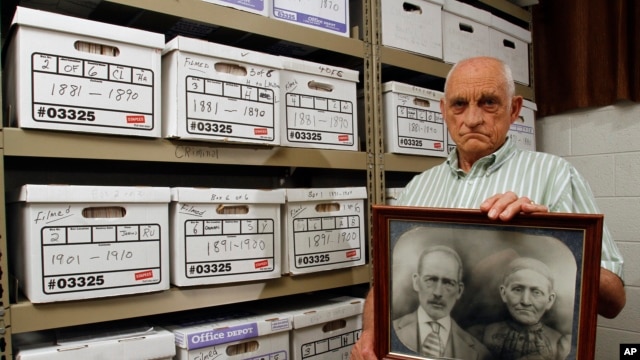
Jack Goins poses with a photo dated to have been taken in 1898 of his great-great grandparents found through genealogical research, May 23, 2012.

Mike Richman

© History Chasers Click here to view all recent Historical Melungeons Blog posts Bookmark and Share

Enter your email address to start receiving this blog in your inbox

Enter your email address:
Delivered by FeedBurner

Sunday, October 20, 2013

Genealogy Sites on Pinterest


If you haven't checked out Pinterest lately for Genealogy sites, you really should do so now.

http://www.pinterest.com/geneabloggers/genealogy-tip-jar/

© History Chasers Click here to view all recent Historical Melungeons Blog posts Bookmark and Share

Enter your email address to start receiving this blog in your inbox


Enter your email address:
Delivered by FeedBurner

Thursday, October 3, 2013

Family Tree DNA Rolls Out a New Look and Interface

With a hat tip to Rebekah Canada: 


FTDNA Family Finder Matches Get a New Look (Part 1)

FTDNA Family Finder Matches look a bit different today. It is a good thing. Here is how a typical Matches page looks when you open it. The first thing I noticed was that the Suggested Relationshipcolumn was gone. This makes me oh so happy. It has been the source of much confusion for a long time.
You will need to head to Family Tree DNA (FTDNA) and Login.


© History Chasers Click here to view all recent Historical Melungeons Blog posts Bookmark and Share

Enter your email address to start receiving this blog in your inbox


Enter your email address:
Delivered by FeedBurner

Junk DNA: Not So Junky Anymore


Is Junk DNA Really Junky?

By 

The delicious, religious debate over what most of our genome is good for.

The silk dancers' interpretation of DNA loops.
Dancers' interpretation of DNA loops
Courtesy of Tom Whipps/Nature
In the 12 years since the human genome was sequenced, so many critters have had their DNA deciphered—oysters, bees, eels, camels, clawed frogs, elephant sharks—that it’s hard to suppress a yawn sometimes. But every so often, a genome cuts through the indifference and makes geneticists’ eyes goggle out. Take the humped bladderwort, a humble aquatic plant whoseDNA was sequenced this past May.
The humped bladderwort has yellow, snapdragon-like flowers, and it’s actually carnivorous, capable of trapping and eating not just insects but even tadpoles and tiny fish. But this combination of beauty and death isn’t what makes the bladderwort special. Most organisms have loads of junk DNA—less pejoratively, noncoding DNA—cluttering their cells. The bladderwort doesn’t: 97 percent of its DNA is classic, hardworking, protein-building DNA. And that lean, mean bladderwort DNA challenges some trendy notions about how all DNA works, including (if not especially) in human beings.
First, a primer on junk DNA, one of the most reviled terms in science. Anyone who took Bio 101 remembers (if only vaguely) that DNA gets turned into RNA, which in turn gets turned into proteins. The protein-producing stretches of DNA are called genes, and genes reside on much longer molecules called chromosomes.
A century ago, as biologists came to grips with the vast number of different proteins needed to build and maintain the body, they decided that genes must be packed very tightly together on chromosomes, since tight packing would be more efficient. They couldn’t have been more wrong. In humans, a typical species in this regard, less than 2 percent of our 3 billion letters of DNA actually builds proteins. Chromosomes were more like vast Saharan wastelands, broken up only sporadically by oases of genes.
So what does that extra 98 percent do? Here’s where things get contentious. Some of the excess—the pseudogenes, the transposons, the tedious stretches where Mother Nature held her fingers down on the keyboard (ACACACACACA ... )—does look like garbage. Heck, 8 percent of our genome is nothing but old, broken-down virus DNA, the genetic equivalent of a Pontiac Firebird on cinderblocks. The name junk DNAemerged in the early 1970s as a catchall term for this cruft.
Even at the time, though, some scientists objected to the term as too dismissive. Molecular biologists had already discovered bits of junk that, far from being irrelevant, actually managed genes: They turned genes on or off and regulated when and where genes were active. As more and more examples of this type of control emerged in the 1980s, the term junk DNA seemed less and less appropriate.

Cont. here:
http://www.slate.com/articles/health_and_science/human_genome/2013/10/junk_dna_debate_critics_of_the_encode_project_cite_humped_bladderwort.html


© History Chasers Click here to view all recent Historical Melungeons Blog posts Bookmark and Share

Enter your email address to start receiving this blog in your inbox


Enter your email address:
Delivered by FeedBurner